Engagement with arts can bring about much-needed stability and connection for marginalised communities.
One of the challenges of creating arts projects with marginalised communities is finding innovative ways to evaluate the work and demonstrate the social value of participating in the arts.
For marginalised communities, engagement with arts can bring about much-needed stability and connection. Yet funding for the arts is constantly in a state of insecurity and artists are often living unpredictable lives.
These are just some of the issues that will be discussed at Massey’s forthcoming symposium Precarity, Creative Arts and Wellbeing to be held on 1-2 September at the Auckland campus Round Room.
Senior Lecturer and one of the event organisers Dr Rand Hazou says, “Working with people who don’t normally engage with the arts and seeing them come alive a bit – seeing their spirit uplifted and a sense of pride – how do we do justice to that?
“How do we document that? How do we evaluate it? And how do we report that back to grant funders? It's not like a direct cause and effect.”
The term 'precarity' applies to all those struggling to make ends meet, which can range from the unemployed to the elderly, disabled, homeless, students, prisoners and refugees, even artists themselves.
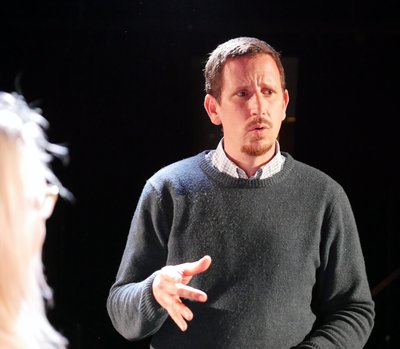
Senior Lecturer Dr Rand Hazou.
Dr Hazou hopes a new book he’s co-editing with the two academic colleagues involved in the symposium, University of Auckland Lecturer Dr Molly Mullen and University of Melbourne Lecturer Dr Sarah Woodland, will offer up some solutions to the funding dilemma.
Entitled Artful Evaluation for Creative Health and Wellbeing, the book will question the power structures and institutions that underpin arts evaluation and call for new methods of evaluating the contribution of participatory arts to health and wellbeing. It’s due to be published late next year.
“There’s a lot of evidence supporting the idea that the arts help wellbeing, but there’s also massive debate about what the evidence actually shows and how credible it is,” Dr Mullen says.
“The World Health Organisation has now taken arts and health on board as a specific area of focus. But with any claim that’s made for the arts outside of the arts realm, like benefitting health, benefitting learning, benefitting social cohesion or whatever it is, there’s always going to be debates and tensions."
“People are aware of the evidence and there's advocacy happening all over the place within the arts and health sectors, but there isn't quite the same widespread acceptance at the political policy level that there has been in other places like the United Kingdom.”
The three academic colleagues bring a wealth of experience in applied theatre to the symposium and the book project. Dr Hazou has led teaching and creative projects engaging with prison, aged-care and street communities and is part of the Health Research Council funded research project Wellbeing and the Precariat.
Dr Mullen’s research focuses on the intersection of policy, funding and practice in applied theatre, while Dr Woodland is currently working on sexual health education for Aboriginal and Torres Strait Islander young people through theatre.
“Whenever this issue of wellbeing comes up, people want to see the hard data, the evidence, right? We’re bringing artists and scholars together to think about ways of shifting that conversation, so we're not always pushed into bean counting and using quantitative methods to show explicit long-term impacts on participants’ lives," Dr Hazou says.
Dr Mullen would like to see organisations and practitioners take more control over how they articulate and measure the value of their work to ensure their methods reflect the organisation and its purpose. Funders, she says, could then engage on that basis.
“What organisations now try to show and measure is often determined either by what funders explicitly want to see or by second-guessing what it is they want to see. That can lead to a bit of a mismatch or even a direct conflict of interest.
“For example, a youth project might take an approach that does not begin with the participants’ problems but rather builds on their existing strengths, whereas the funder might take a very deficit-based approach focused on how the project is fixing the problems.
“So the organisation is put into quite an uncomfortable position with how they're expected to represent the people that they're working with," Dr Hazou explains.
In Melbourne, Dr Woodland says there’s often funding available for programmes if you know how to articulate them in ways that the funders understand.
“That is the biggest challenge, to be able to translate the organic, ephemeral processes that characterise art, creativity and the legacies of millennia of knowledges and cultural practices into a language that a mainstream funder understands."
She says the most challenging aspect of working in cross-cultural partnerships with Aboriginal and Torres Strait Islander communities is being required to work within Western institutional frameworks such as universities, funders and health departments.
“You have to respond to their timelines, needs and expectations while also attempting to privilege First Nations ways of knowing, being and doing – which centre holistic, relational approaches that take time.”
But Dr Woodland has nothing but praise for the funders of her most recent project, the Australian Institute for Aboriginal and Torres Strait Islander Studies.
“It has been extremely refreshing in the way that they ‘get it’,” she says.
Related news
Massey artists feature in collaborative climate art installation
Staff from the School of Humanities, Media and Creative Communication are involved in an artistic installation taking place on the Wellington Waterfront next week.
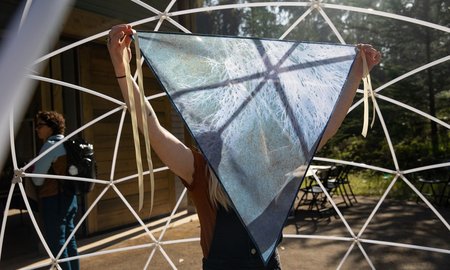
ECOPOESIS. Wait, what?
When visiting Professor of Creative Writing Leslie Roberts gets anxious about climate change, she gathers people to eat, drink and make some collective art and calls it ECOPOESIS.